


Uniswap price rebounded 8% from its July 29 intraday low as Hayden Adams addressed concerns over v4 protocol fees, helping UNI reclaim the $4 psychological level.
- UNI recovered from $3.74 to $4.06, producing an intraday rebound of more than 8%.
- Daily RSI reached 66.83, showing strong momentum without entering overbought territory.
- The 4-hour chart places immediate resistance between $4.10 and $4.30.
- A rising wedge and weak 19.77 ADX leave UNI exposed to a short-term pullback.
Uniswap price returns above $4
According to data from crypto.news, Uniswap (UNI) price traded at $4.02 at the time of writing after briefly reaching $4.06, according to the Binance daily chart. The intraday rebound from $3.74 amounted to about 8.5%, while the token was up roughly 3% from its daily opening price.
UNI has now recovered more than 70% from its June low near $2.35. The rally has formed a sequence of higher highs and higher lows, allowing the token to return to a price area last tested in May.
Momentum remains favorable on the daily timeframe. UNI is trading above its Supertrend support at $3.23, while the relative strength index has risen to 66.83. The RSI remains below the standard overbought threshold of 70, although the reading shows that buying conditions are becoming stretched.
The daily candle also approached the May swing high near $4.15. A close above that level would strengthen the case that UNI has moved beyond a temporary relief rally and entered a broader recovery phase.
Hayden Adams addresses Uniswap v4 fee concerns
The immediate move followed comments from Uniswap founder Hayden Adams about the protocol’s v4 fee structure.
Adams said the protocol fee would be added to the liquidity provider fee instead of being deducted from it. Under his example, traders using a pool with a 30-basis-point liquidity provider fee would pay 35 basis points in total. Liquidity providers would continue receiving 30 basis points, while five basis points would go to the protocol.
The clarification addressed concerns that activating protocol fees would lower returns for liquidity providers and potentially push capital toward competing decentralized exchanges.
Uniswap has also submitted governance proposals covering protocol fees from v4 pools and deployments on Robinhood Chain. The proposals would send new protocol revenue into the existing UNI burn mechanism, creating a clearer connection between exchange activity and the token’s circulating supply.
That connection has gained attention since Robinhood Chain launched on July 1. Uniswap generated about $5.16 million in fees during one 24-hour period earlier this month, according to DefiLlama data cited by crypto.news. Roughly $4.38 million came from Robinhood Chain.
Uniswap volume on the network crossed $1 billion within nine days of launch. However, future UNI burns will still depend on governance approval, fee collection and sustained trading activity.
UNI faces resistance between $4.10 and $4.30
The 4-hour chart shows that UNI has moved above the $4.00 top of its recent trading range. The next technical level sits at $4.10, identified by the Murrey Math indicator as a strong reversal pivot.
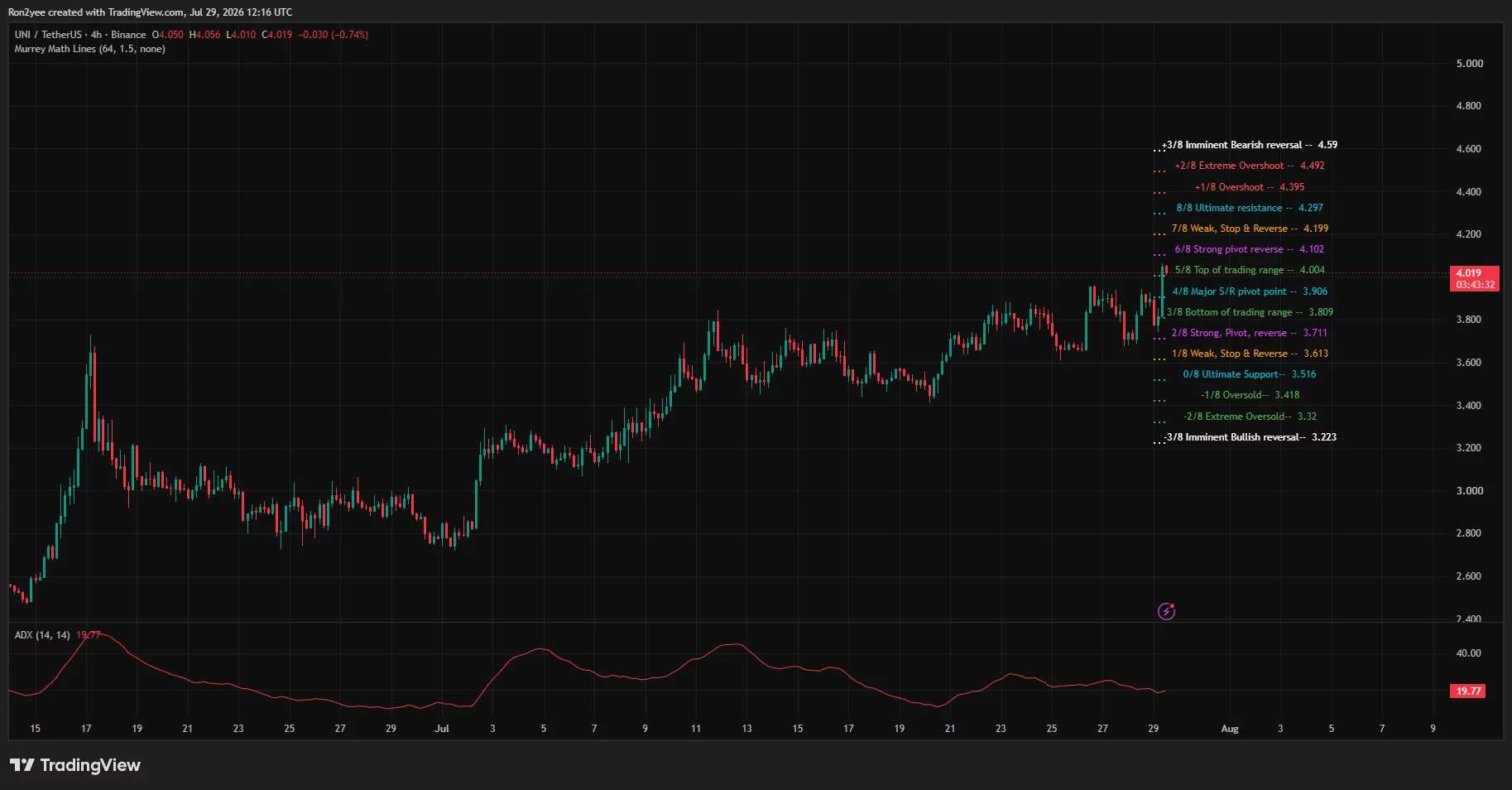
A sustained close above $4.10 could open the path toward $4.20 and $4.30. The latter represents the indicator’s ultimate resistance level. Beyond that, the chart places extended targets at $4.40, $4.49 and $4.59.
However, the average directional index stands at 19.77. An ADX reading below 20 suggests that the current trend has not yet developed strong directional conviction, despite the price breakout.
The one-week CoinGlass liquidation heatmap also shows a dense concentration of leveraged positions around $3.98 to $4.03. UNI’s move through this area likely forced some short sellers to close their positions, adding buy pressure to the rebound.
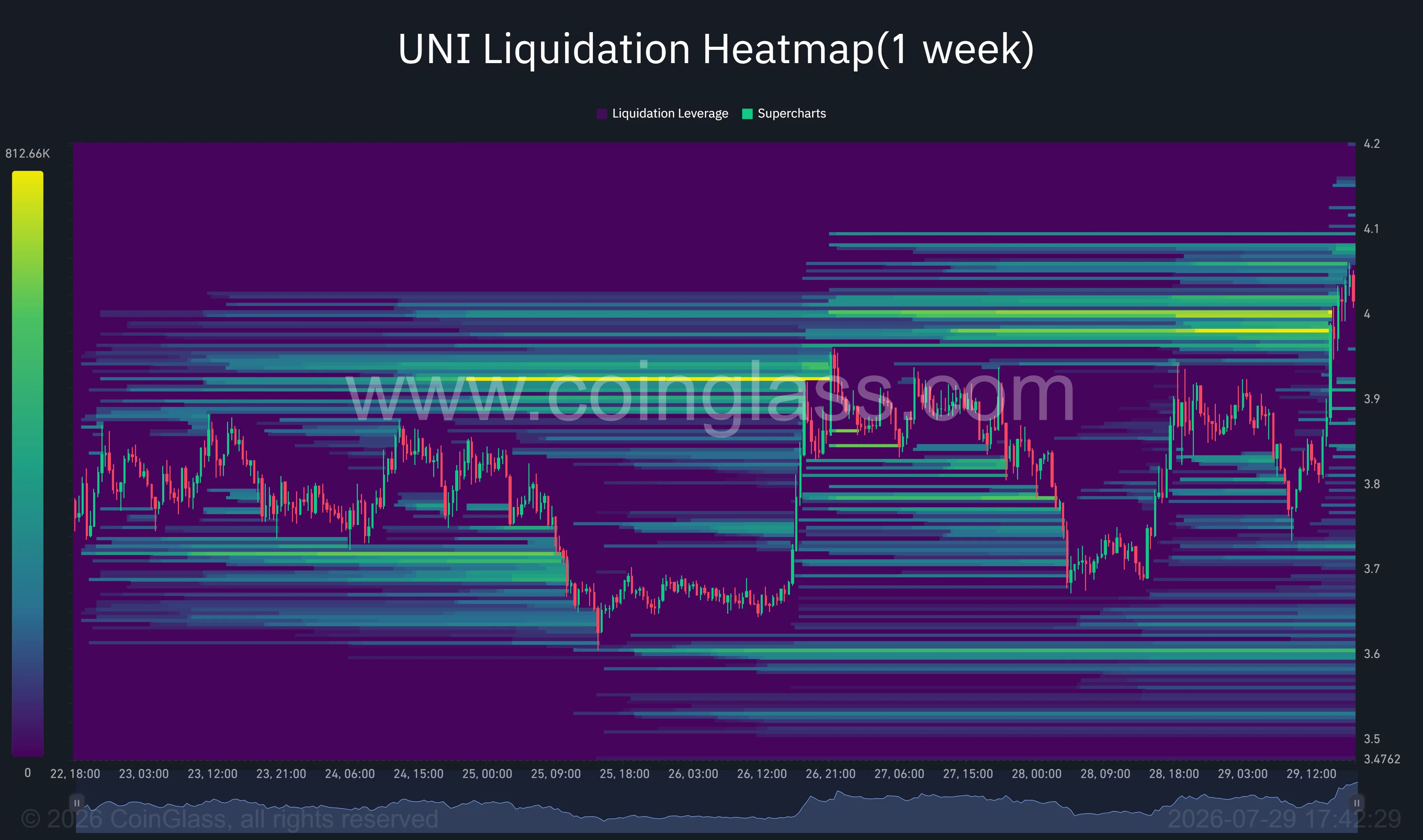
Additional liquidity is visible near $4.07 to $4.10, making that zone a possible short-term price target. On the downside, the main liquidity clusters sit near $3.90, $3.72 and $3.60.
If UNI loses $4.00, the 4-hour chart identifies $3.91 as the first support. Lower levels appear at $3.81 and $3.71. The bullish structure would weaken more clearly below the $3.52 support zone.
Analysts see breakout and pullback scenarios
Analyst Gopal identified a rising wedge on the UNI chart, noting that the token continues to form higher highs and higher lows inside a narrowing structure.
According to the analyst, repeated tests of wedge support suggest that bullish momentum may be losing strength. A confirmed break below the lower trendline could cause a deeper correction, while a breakout above the upper boundary would invalidate the bearish setup.
Nebraska Gooner also described UNI as being at resistance. The analyst said reclaiming the red resistance area on his chart could create a moving-average squeeze and lead to a stronger rally. His setup points toward the $5 region if UNI establishes support above the current barrier.
The two views make the $4.10–$4.30 range central to UNI’s next move. A confirmed breakout would reduce the risk posed by the rising wedge, while rejection could send the token back toward $3.80 or the ascending support line.
US macro conditions remain a risk for UNI
Uniswap’s growth on Robinhood Chain gives the rally a direct US market connection. The network has brought decentralized trading infrastructure closer to Robinhood’s user base, while Uniswap’s Permissioned Pools could support tokenized funds and equities subject to investor eligibility rules.
Uniswap Labs launched Permissioned Pools with Securitize, Superstate and Dowgo as early participants. The v4-based framework allows issuers to control which wallets can trade or provide liquidity, making it more suitable for regulated assets.
Still, UNI’s breakout comes ahead of a Federal Reserve rate decision that could drive volatility across US stocks and crypto. A hawkish policy signal could reduce demand for risk assets, and pressure leveraged UNI positions.
UNI must therefore hold above $4.00 and clear $4.10 to confirm the breakout. Failure to do so would leave the rising-wedge warning active, with $3.81 and $3.71 serving as the next levels to watch.
Disclosure: This article does not represent investment advice. The content and materials featured on this page are for educational purposes only.