


Pi Network price rose toward $0.093 on Aug. 6 as buyers targeted a double-bottom breakout ahead of the Protocol 26 node deadline.
- Pi Network price rose about 12% over seven days, outperforming the wider crypto market.
- A 4-hour double bottom places the key neckline resistance at $0.102.
- The daily chart shows PI breaking above a descending channel as CMF turned positive.
- Protocol 26 and the RoboPay announcement have supported sentiment, but $0.095–$0.102 remains a major barrier.
Pi Network price extends its weekly recovery
According to data from crypto.news, Pi Network (PI) price traded near $0.093 at the time of writing after reaching an intraday high of approximately $0.096. The token has gained around 12% over the past week, extending its recovery from July’s all-time low near $0.071.
Trading activity has also increased driving the token’s price up. CoinGecko data showed approximately $14.3 million in 24-hour volume, up about 88% from the previous day. PI’s market capitalization stood above $1 billion.
The move has pushed PI above the upper boundary of the descending channel visible on the daily chart. That channel had controlled price action since late April, when the token traded near $0.20.
A daily close above the former channel resistance around $0.088–$0.090 would strengthen the breakout. Failure to hold that area, however, could turn the latest move into another temporary recovery within the broader downtrend.
PI remains more than 96% below its February 2025 record high, meaning the recent weekly rally has yet to reverse its longer-term bearish structure.
Double bottom points to $0.102 neckline
The 4-hour chart shows PI forming a potential double bottom after buyers defended the $0.072–$0.075 region twice in July. The first low formed around July 14, followed by another test near July 28.
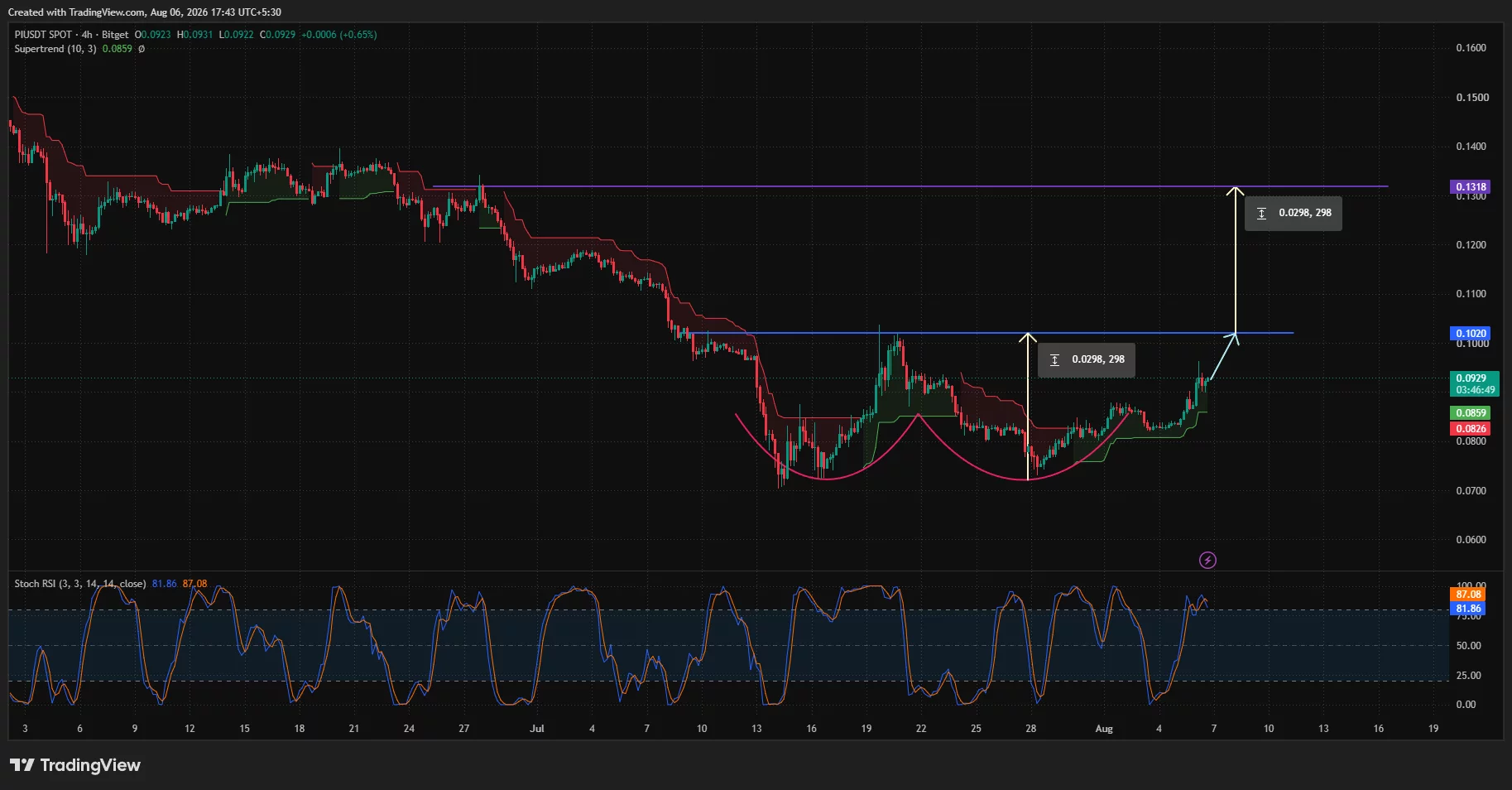
Price has since climbed toward the pattern’s neckline at $0.102. A double bottom becomes confirmed only after price closes above its neckline, so the setup remains incomplete while PI trades near $0.093.
A confirmed breakout above $0.102 would activate a measured target near $0.132. This projection comes from adding the pattern’s approximate $0.030 depth to the neckline.
The target would represent an increase of roughly 42% from the current price. It also corresponds with a former consolidation area that acted as support during June before PI’s decline accelerated.
Before reaching the neckline, bulls must clear the immediate $0.094–$0.096 resistance zone. Analyst Crypto With Gopal identified a smaller falling wedge on the intraday chart, arguing that a move above $0.094–$0.095 could open the path toward $0.098–$0.10.
Technical indicators favor buyers but warn of overheating
Momentum indicators support the improving short-term structure. The daily Aroon Up reading has reached 100%, compared with an Aroon Down reading of 35.71%. The difference suggests recent highs are forming more frequently than new lows.
The Chaikin Money Flow indicator has also moved above zero to 0.07. A positive reading indicates that buying pressure is beginning to exceed selling pressure, although the value remains too modest to signal overwhelming accumulation.
PI has also flipped the 4-hour Supertrend indicator bullish. The indicator now places dynamic support near $0.086, while the previous bearish threshold sits around $0.083.
However, the 4-hour Stochastic RSI has climbed into overbought territory. Its two lines stand near 82 and 87, raising the possibility of a short-term pullback or consolidation before another attempt at the neckline.
A retreat toward $0.090 would not invalidate the bullish setup if buyers defend that level. Below it, $0.086 represents the next support, followed by the $0.082–$0.083 zone. A breakdown under $0.075 would invalidate the double-bottom structure.
Protocol 26 deadline supports Pi Network sentiment
The rebound comes as Pi Network rolls out Protocol 26 across its Mainnet infrastructure. The project’s official node page says all Mainnet nodes must upgrade to version 26, while operators face an Aug. 11 deadline to complete the transition.
Protocol 26 is therefore already being deployed rather than awaiting an initial launch. The approaching deadline could support interest in PI, but it also creates execution risk if node operators fail to update in time.
The network recently completed its second Launchpad test involving the SLICE test token. According to Pi Network, more than 242,000 participants committed 15.92 million Test-Pi to acquire 10 million SLICE tokens between June 11 and June 28.
Those assets were testnet tokens and did not represent spot-market purchases of PI. The trial focused on Launchpad allocation, liquidity-pool mechanics, and automated token pricing, making it an ecosystem test rather than direct evidence of mainnet accumulation.
Fabric Foundation also announced that Pi Network had joined RoboPay as a payment partner. The planned integration would allow PI to pay for robot services across the Fabric network, although the rollout and resulting transaction demand remain unproven.
Can PI price break above $0.10?
PI’s immediate outlook depends on whether buyers can turn the daily channel breakout into sustained momentum. A move through $0.095 would expose $0.098 and the psychologically important $0.10 level.
The decisive test sits at $0.102. Closing above that neckline with expanding volume would confirm the double bottom and bring $0.115 and $0.132 into view.
Rejection between $0.095 and $0.102 could send PI back toward $0.090 or the 4-hour Supertrend support near $0.086. Supply growth and future token unlocks remain additional risks if spot demand weakens.
For U.S. traders, PI availability remains narrower than that of established cryptocurrencies. CoinGecko lists OKX, Gate, and Bitget among its main markets, while access can vary by jurisdiction. The limited distribution may increase volatility and make price discovery more dependent on offshore venues.
Disclosure: This article does not represent investment advice. The content and materials featured on this page are for educational purposes only.