

BNP Paribas has forecast three Federal Reserve rate hikes beginning in December, citing stronger-than-expected U.S. employment data and rising inflation pressures that the bank links in part to the ongoing U.S.-Iran conflict.
- BNP Paribas expects the Fed to deliver three rate hikes starting in December as inflation risks rise.
- Strong U.S. jobs data boosted market expectations for tighter monetary policy.
- Polymarket and CME FedWatch data show traders increasingly pricing in the possibility of higher rates.
According to a Markets 360 analysis from BNP Paribas, the bank has abandoned its previous expectation for stable policy and now expects the Fed to reverse the three interest rate cuts delivered in 2025 through a series of hikes at consecutive Federal Open Market Committee meetings starting at the end of this year.
The bank said policymakers may need to remove some monetary stimulus as inflation risks intensify while labor market conditions remain firm. BNP Paribas also projected that the unemployment rate could gradually fall to 4% by year-end, a level that would give the central bank more room to focus on price pressures.
Fresh labor market data released this week appears to support the bank’s view that the economy remains resilient. U.S. nonfarm payrolls increased by 172,000 last month, far exceeding economists’ forecasts of 85,000. The unemployment rate remained unchanged at 4.3%.
Markets are increasingly pricing in higher rates
Following the jobs report, prediction markets and interest-rate traders moved toward a more hawkish outlook.
Data from Polymarket now shows a 52% probability that the Federal Reserve will raise rates before the end of the year. The odds reached their highest level so far after the stronger-than-expected payroll figures were published.
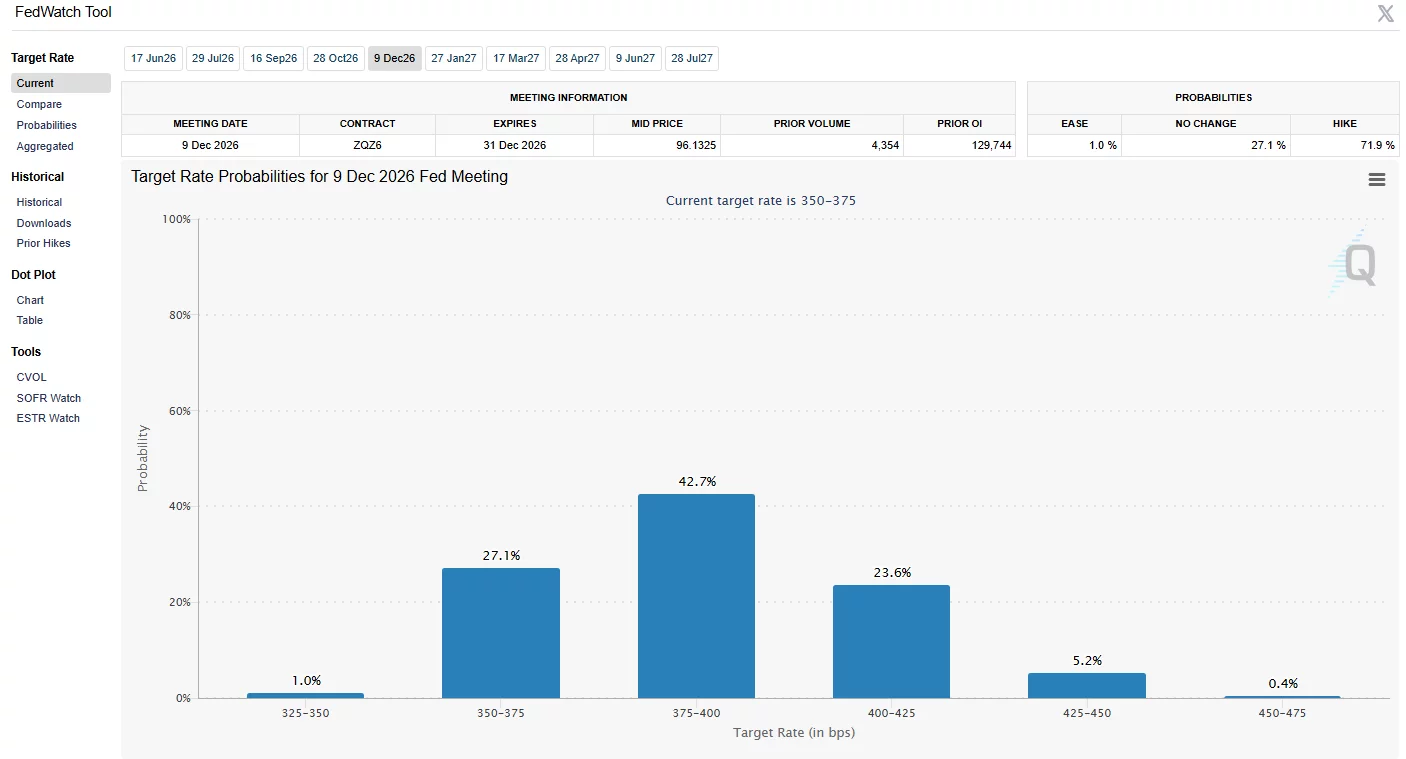
At the same time, CME FedWatch data indicates a 42.7% chance that rates will be higher by December this year. Futures traders continue to expect policymakers to leave rates unchanged for most of the year, while assigning only a limited probability to additional cuts.
Those expectations have emerged as inflation remains above the Federal Reserve’s long-term target and geopolitical tensions raise concerns about fresh price increases.
Fed officials and former policymakers remain divided
While BNP Paribas expects tighter monetary policy, some current Federal Reserve officials have continued to argue for patience.
Recent remarks from Mary Daly highlighted a more cautious approach. According to a summary of her comments reported by crypto.news last week, Daly said restoring price stability remains essential but warned that the Fed cannot achieve that objective by damaging the economy.
Daly has also argued in previous speeches that policymakers are in a position to wait for more data before making major policy changes.
Her stance contrasts with concerns raised by former New York Fed President Bill Dudley, who has repeatedly warned that the central bank risks undermining its credibility if inflation remains above its 2% target for too long.
In recent commentary and interviews, Dudley argued that inflation has exceeded the Fed’s objective for more than five years, yet policymakers have increasingly discussed rate cuts. He has also maintained that the neutral interest rate, often referred to as r*, is likely higher than officials currently assume, suggesting monetary policy may not be as restrictive as it appears.
According to Dudley, the bigger danger lies in inflation expectations becoming entrenched. He has cautioned that households and financial markets could begin treating inflation in the 3% to 5% range as normal if price growth stays elevated for an extended period. In his view, bringing inflation back to target under those conditions could eventually require much more aggressive action from the Federal Reserve.