


Ethereum traded near $1,867 on Tuesday as weak US demand and a bearish 4-hour setup kept the price below a major technical and liquidity zone.
- ETH price remained below $1,875, the bottom of its daily trading range.
- 4-hour Supertrend resistance sits near $1,907, while ADX fell to 16.19.
- The largest 1-week liquidation cluster is concentrated around $1,935–$1,945.
- Ethereum’s Coinbase Premium Index remained negative at -0.083, signaling weaker US demand.
Ethereum price remains trapped below $1,875
According to data from crypto.news, Ethereum (ETH) price traded at approximately $1,867 at the time of the charts, up about 0.3% on the day. The token has moved sideways since falling from its late-July peak near $1,970.
The daily chart places ETH just below the $1,875 Murrey Math level, which represents the bottom of its current trading range. Buyers have tested this area several times since mid-July but have not converted it into sustained support.
Ethereum’s recovery from its June low near $1,500 remains intact on the broader chart. However, momentum has weakened after the price failed to clear the $1,950–$2,000 region.
The $2,000 level is both a psychological barrier and a major technical pivot. A daily close above it would give buyers a clearer path toward $2,125, the next Murrey Math resistance.
Aroon data showed a mixed but moderately constructive longer-term setup. The Aroon Up reading stood at 78.57%, compared with an Aroon Down reading of 42.86%, indicating that recent highs still carry more weight than recent lows.
Weak momentum keeps ETH below $1,907
Ethereum’s 4-hour chart remains more defensive. ETH is trading below the Supertrend resistance at $1,907, leaving the short-term indicator in bearish territory.
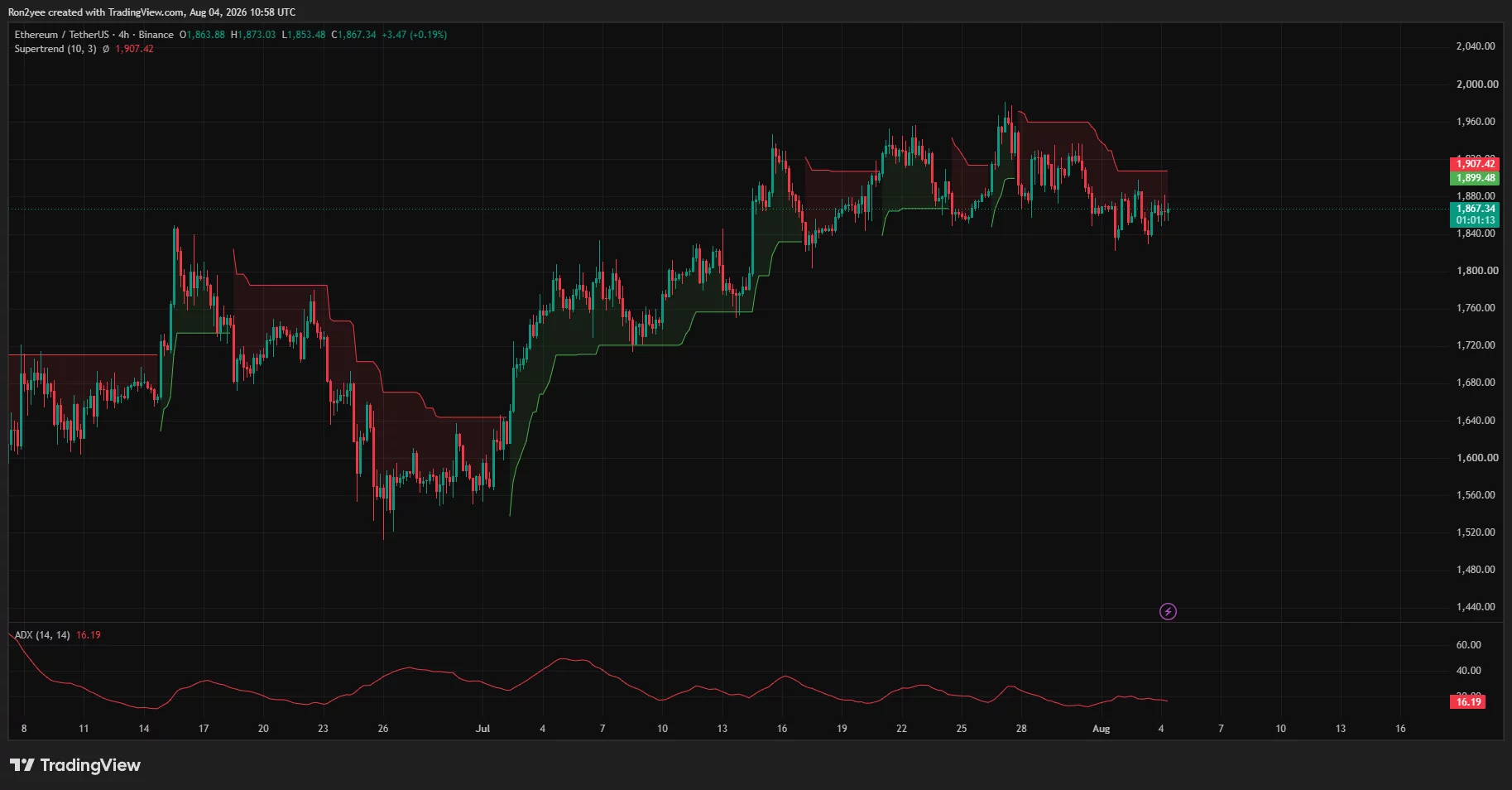
The price would need to break and hold above the $1,900–$1,907 area to invalidate that signal. That move could open the way for another test of $1,940 and the late-July highs near $1,970.
However, the Average Directional Index stood at 16.19. An ADX reading below 20 generally points to a weak trend, suggesting neither buyers nor sellers currently have firm control.
That raises the possibility of continued consolidation between approximately $1,840 and $1,900. A move outside that range, accompanied by stronger volume, would provide a clearer directional signal.
A break below $1,840 would expose the early-August low around $1,825. Further selling could pull ETH toward $1,800, followed by the stronger daily pivot at $1,750.
ETH liquidation map points to $1,940
CoinGlass’ one-week liquidation heatmap shows the largest concentration of leveraged positions above Ethereum’s current price.
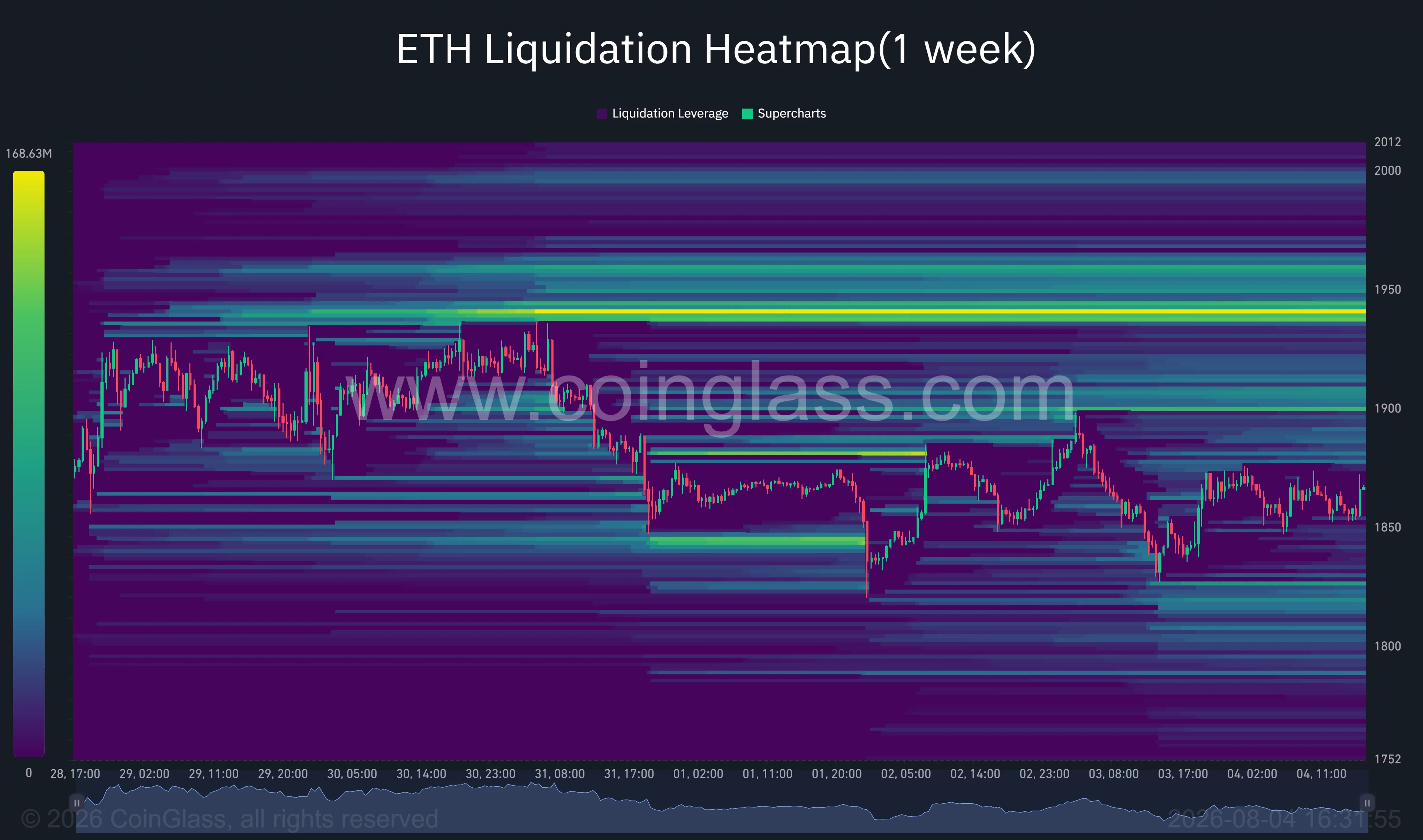
The brightest liquidity band sits around $1,935–$1,945, making it the most visible short-term target if ETH breaks above $1,900. Additional liquidation clusters appear around $1,955–$1,970 and close to $2,000.
These zones could attract price because large concentrations of short liquidations often become targets during an upside move. A push through $1,940 could therefore accelerate if forced short covering adds to spot demand.
Liquidity also sits below the current price, although the clusters are less concentrated. The main downside areas appear near $1,820 and $1,800, where leveraged long positions could face pressure if $1,840 fails.
The heatmap does not determine which level Ethereum will reach first. It instead shows where forced liquidations could add volatility once the price begins moving decisively.
US Ethereum demand remains weak
Ethereum’s Coinbase Premium Index stood at approximately -0.083 in a CryptoQuant chart shared by market commentator Crypto Patel. A negative premium means ETH was trading at a lower price on Coinbase than on other major exchanges.
Because Coinbase serves a large US customer base, the reading suggests American investors and institutions are buying less aggressively than traders elsewhere.
“Global demand for ETH is stronger than U.S. demand right now,” Patel said.
The negative premium coincides with reduced demand from US spot Ethereum ETFs after earlier inflows helped support the market. Stablecoin liquidity has also weakened, with Binance net inflows reportedly falling 518% week over week.
These conditions leave Ethereum more dependent on demand from offshore exchanges. A return to a positive Coinbase premium would indicate that US buyers are re-entering and could strengthen the case for a move above $1,900.
US investors are also monitoring Federal Reserve policy and stalled crypto legislation. Uncertainty around interest rates and the Senate’s CLARITY Act timetable has kept institutional positioning defensive across the broader digital-asset market.
ETH/BTC strength offers a bullish counterpoint
Ethereum continues to show relative strength against Bitcoin despite its weak dollar-denominated price action.
Analyst Michaël van de Poppe said the ETH/BTC pair remains in a “solid uptrend,” arguing that the recent pullback has not broken its broader recovery structure.
That relative strength could become important if crypto capital begins rotating from Bitcoin into larger altcoins. However, ETH must still reclaim $1,907 and clear the $1,940 liquidation zone before its US dollar chart confirms renewed upside momentum.
Until then, $1,840 and $1,800 remain the main downside levels, while $1,907, $1,940 and $2,000 form the immediate resistance ladder.
Disclosure: This article does not represent investment advice. The content and materials featured on this page are for educational purposes only.