


TRON surpassed 15 billion total transactions on Aug. 4, extending a period of network growth driven largely by stablecoin transfers and payment activity.
- TRON surpassed 15 billion lifetime transactions, while daily activity exceeded 12.5 million transactions on Tuesday.
- USDT remained TRON’s busiest, recording 2.55 million transfers and $28.1 billion in onchain volume yesterday.
- TRON held more than $90 billion in USDT supply, strengthening its stablecoin settlement role globally.
- TRX traded near $0.3155, showing no clear breakout linked directly to the transaction milestone Tuesday.
- Q2 data showed TRON captured 34% of crypto card volume, the highest reported network share.
TRONSCAN showed 15,008,156,417 confirmed transactions at the time of writing. The network processed more than 12.56 million transactions during the preceding 24 hours. Total registered accounts stood at 396.74 million, after increasing by about 158,871 over the same period.
The milestone is a cumulative count of confirmed network operations. It includes token transfers, smart contract calls, staking activity and other recorded actions. It does not represent 15 billion unique payments or users.
TRON’s 15 billion transactions reflect sustained daily use
The latest total follows strong activity during the opening months of 2026. TRON DAO reported that the blockchain processed 950 million transactions during the first quarter, a 0.62% increase from the previous quarter. The network also supported $2.04 trillion in stablecoin settlement during that period.
Current TRONSCAN data suggest daily use has accelerated since then. The explorer recorded more than 12.5 million transactions over the latest 24 hour period. For comparison, the network averaged about 10.4 million transactions per day during the first quarter, based on TRON DAO’s quarterly total.
However, the cumulative milestone alone does not show how many transactions represent new economic activity. Automated transfers, repeated smart contract interactions and resource management operations also contribute to the count. Transaction value, active users and stablecoin flows provide additional context.
TRONSCAN reported 4.65 million active accounts for the previous day. Its 30 day average stood at about 4.74 million. The network was also processing 194 transactions per second when the dashboard was captured, against a recorded maximum of 1,035.
USDT activity remains the main engine behind TRON growth
Tether’s USDT remained the most active token on TRON. TRONSCAN recorded nearly 2.55 million USDT transfers during the previous day, representing about $28.1 billion in transfer volume. TRX itself recorded roughly 4.49 million transfers, although their combined value was much lower at about $195 million.
The total supply of USDT on TRON reached approximately $90.28 billion. More than 75.37 million accounts held the stablecoin, while seven day transfer volume stood at $157.44 billion.
As crypto.news previously reported, TRON had already become a leading network for everyday USDT transfers by mid 2025. CryptoQuant found that the blockchain processed between 2.3 million and 2.4 million daily USDT transactions during that period, almost seven times Ethereum’s count.
A CoinDesk Research report commissioned by TRON found that the network’s USDT supply reached about $89 billion during the second quarter of 2026. The report said TRON accounted for just over 47% of total USDT supply and 52% of transfers below $1,000 across blockchains with native Tether issuance.
The same report found that about 93% of TRON’s stablecoin transfer volume involved direct transfers between addresses rather than protocol interactions. That structure supports the view that payments and peer to peer transfers remain central to the network’s use.
Payment data show adoption beyond token transfers
TRON’s role in payments also extends to crypto linked cards. CoinDesk Research said the wider crypto card market processed $2.4 billion during the second quarter, up from $2 billion in the first quarter. TRON’s share increased from 33% to 34%, the largest among the networks included in the report.
The report also placed TRON’s average daily active users at 3.5 million during the quarter. Protocol fees reached $89 million, second only to Hyperliquid among the networks compared. These figures indicate that transaction growth is producing fee revenue, rather than consisting entirely of subsidized activity.
Still, stablecoin concentration creates a dependency. USDT dominates token transfers and accounts for much of TRON’s payment activity. Any change in Tether issuance, compliance policies or user demand could therefore affect network activity.
In related coverage, crypto.news reported that TRON extended its USDT lead over Ethereum as active addresses and weekly transaction counts rose. The analysis also found that TRX price performance did not always follow improvements in network data.
TRX remains below its $0.34 breakout level
TRX did not record a confirmed breakout as the transaction count crossed 15 billion. TRONSCAN had displayed TRX around $0.3292 earlier, alongside a market capitalization of approximately $31.17 billion.
The daily chart supplied with the market update showed TRX consolidating after its June pullback. The token had remained between support near $0.31 to $0.32 and resistance around $0.34.
Its relative strength index stood at 54.10, slightly above the neutral 50 level and its moving average of 51.84. That suggested mild positive momentum at the time of the chart snapshot. The MACD lines remained close together, while the histogram was only slightly positive, showing limited directional strength.
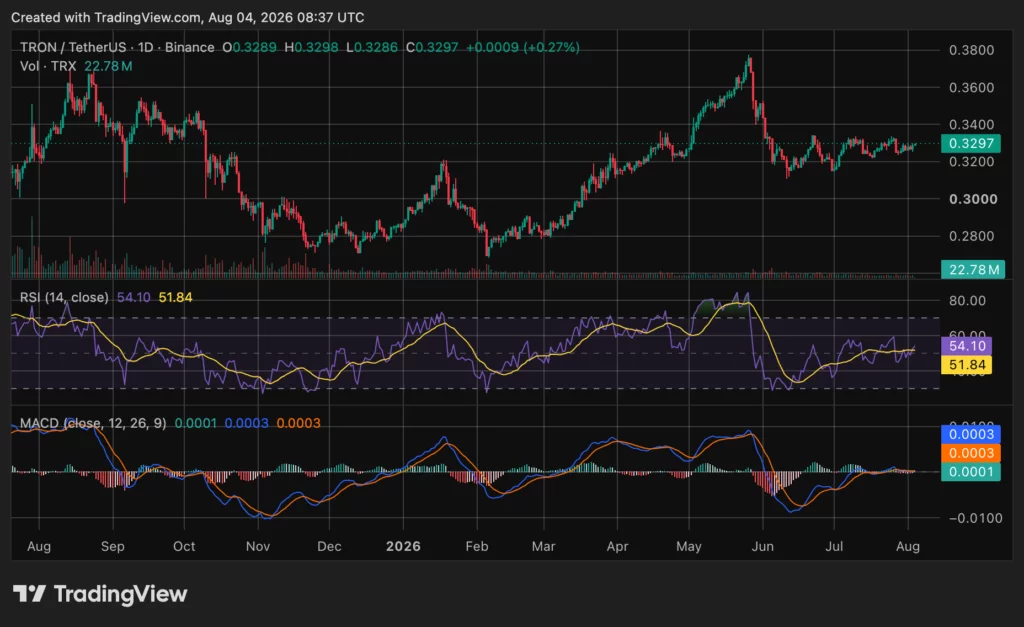
A sustained move above $0.34 would improve the recovery structure and could attract stronger momentum. A loss of the $0.31 to $0.32 area would weaken the current range and place the late 2025 support region near $0.27 to $0.28 back in focus.
Disclosure: This article does not represent investment advice. The content and materials featured on this page are for educational purposes only.