


Zcash price has fallen toward the $500 psychological support as a 4-hour breakdown, leveraged liquidations, and caution before the Ironwood upgrade have weakened market sentiment.
- Zcash price has fallen toward $500 after losing $520 and triggering more than $2 million in long liquidations.
- Bulls must reclaim $530 to neutralize the bearish structure, while $550 remains the main breakout level.
- A daily close below $477 could expose $466 and the rounded-top target near $371.
According to data from crypto.news, Zcash (ZEC) price traded near $502 on July 24 after losing about 5.5% over the past week. Sellers took control after the token lost $520, while more than $2 million in long positions were liquidated over 24 hours. Automated stop orders added pressure once price slipped through intermediate support at $510.
Outside crypto, Thursday’s technology rout reduced demand for risk assets. The Magnificent Seven erased about $797 billion in market value after Alphabet and Tesla’s earnings raised concerns over heavy artificial intelligence spending. The Nasdaq Composite fell more than 2%, while Tesla dropped 14% and Alphabet lost almost 7%.
Oil and bond markets added another obstacle. Brent crude briefly moved above $100 after Houthi attacks on two Saudi tankers raised fears of disruption in the Red Sea. The 10-year U.S. Treasury yield reached an 18-month high near 4.70%, making speculative assets less attractive as traders reconsidered expectations for lower interest rates.
Crypto funds also lost institutional capital during the selloff. U.S. spot Bitcoin exchange-traded funds recorded $225 million in net outflows on July 23. BlackRock’s IBIT accounted for $202 million of the withdrawals, extending the defensive mood into altcoins such as ZEC.
Zcash price must reclaim $530 to repair its short-term structure
On the daily chart, ZEC has fallen below its 20-day simple moving average at $514.77 but remains above the 50-day SMA at $477.05 and the 100-day SMA at $466.50. Those averages form the first major support area if bulls cannot hold $500. The 200-day SMA sits much lower at $382.96.
Bear-bull power has dropped to minus 25.48, which shows that sellers have gained control after ZEC’s rejection near $570. However, the token remains above its medium- and long-term averages, leaving the daily recovery structure intact unless price closes decisively below the $466–$477 zone.
The 4-hour chart carries a more bearish setup. ZEC has formed a rounded-top structure since its July 15 peak near $580, with price now testing the $500 area. A confirmed breakdown could extend toward $470 before exposing the pattern’s main support and projected target around $370.69.
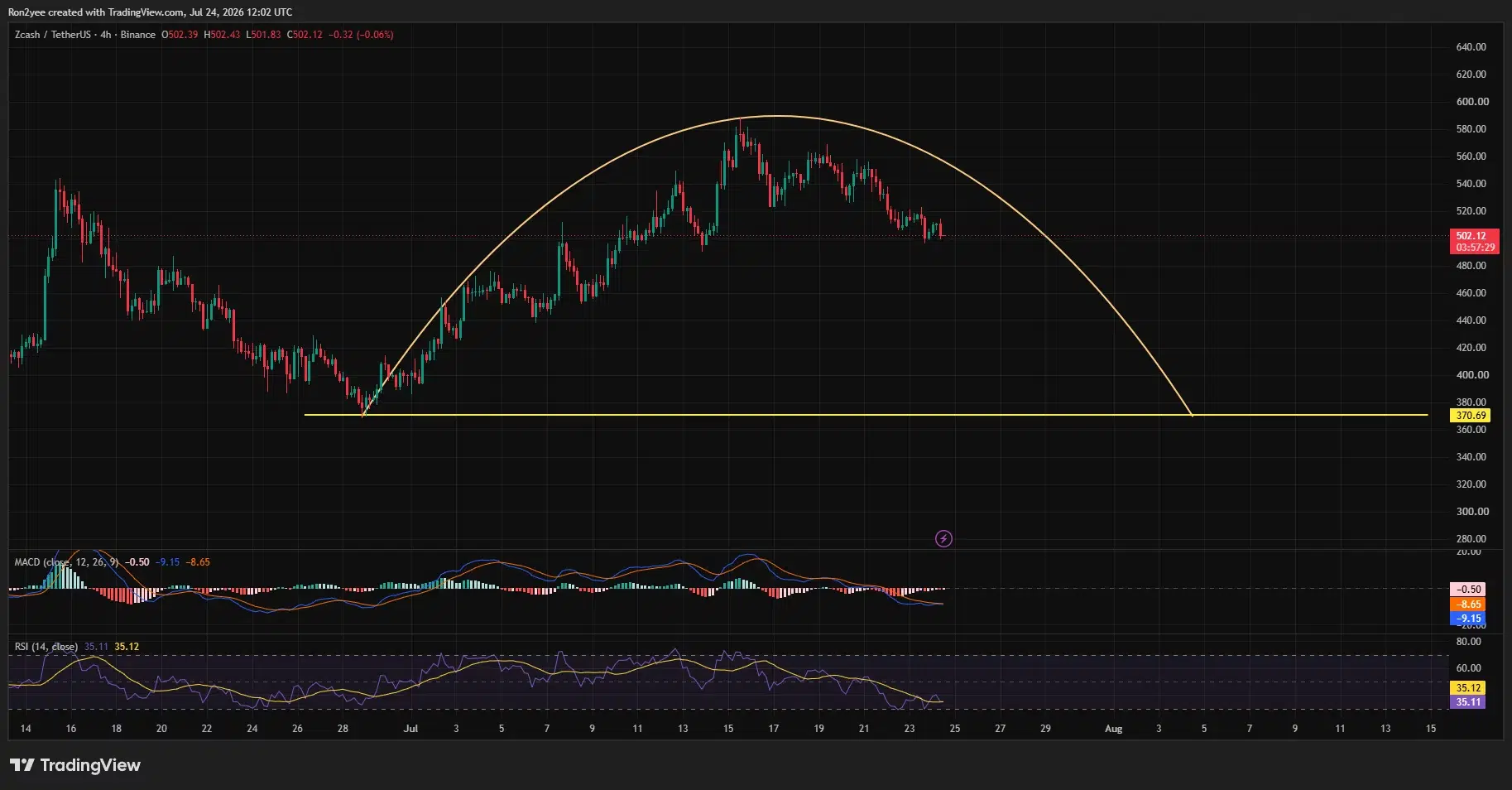
Momentum readings have yet to confirm a reversal. The 4-hour Relative Strength Index stands at 35.11, close to oversold territory but still above 30. The Moving Average Convergence Divergence line remains below its signal line at minus 9.15 versus minus 8.65, while the negative histogram shows that sellers retain an advantage.
According to trader Ardi, $500 has become the main liquidity pivot after ZEC lost $520. The trader expects a brief move below the threshold before any sustained recovery and wrote:
“A reclaim of $530 would return the chart to neutral and likely begin a sideways consolidation phase.”
Ardi identified $550 as the level that would fully break the current bearish structure. Beyond it, $620 would become the next macro breakout barrier. Failure to protect $500, however, could force the trader to close the remaining long position established near $425.
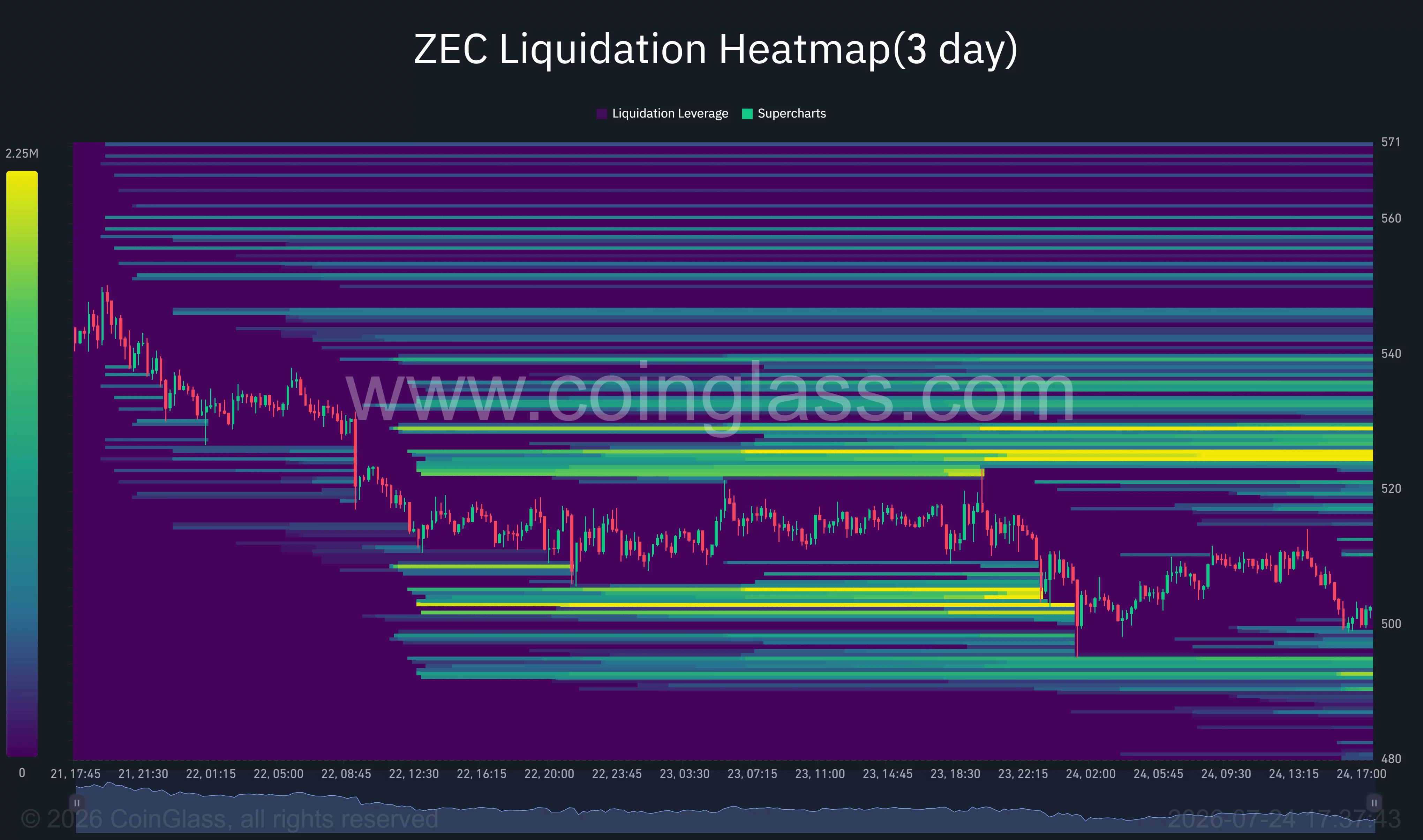
CoinGlass’s three-day liquidation heatmap places the strongest overhead concentration between $524 and $529. A rebound into that band could force short sellers to exit and help ZEC challenge Ardi’s $530 neutral level. Below the market, another dense leverage pocket sits around $490–$494, making that range a likely destination if $500 gives way.
Derivatives traders have not turned fully bearish. ZEC’s funding rate remained positive at approximately 0.0076%, showing that long positions still pay shorts. Yet falling open interest and weaker spot volume show that fewer traders are willing to carry leverage through the current decline, limiting the fuel available for an immediate rebound.
Loss of $477 would invalidate the remaining bullish setup
Ironwood, also known as NU6.3, will activate at block 3,428,143 on July 28. The upgrade will retire the vulnerable Orchard shielded pool and introduce a corrected pool. Funds leaving Orchard must pass through an accounting turnstile designed to prevent more ZEC from exiting than originally entered.
Zcash founder Zooko Wilcox has explained that the process cannot identify individual counterfeit coins or prove that the flaw was never exploited. Temporary wallet and exchange interruptions may occur as service providers update their systems, giving short-term traders another reason to reduce exposure before activation.
Zakura offers a longer-term counterweight to those concerns. The new Rust-based full-node client targets 50,000 private transactions per second and can reportedly start from a pruned snapshot in under two minutes. Still, the development has not stopped the current price correction.
A daily close below the 50-day SMA at $477.05 would weaken the primary recovery thesis and expose $466.50, followed by the June support region near $370. Continued ETF withdrawals, high Treasury yields, another oil spike, or complications during Ironwood activation would increase that downside risk. Bulls must first defend $500 and reclaim $530 before ZEC can make another attempt at $550.
Disclosure: This article does not represent investment advice. The content and materials featured on this page are for educational purposes only.