


Disclosure: This article does not represent investment advice. The content and materials featured on this page are for educational purposes only.
Poly Truth redefines prediction markets with AI-driven analysis tools for data-based decision making.
- Poly Truth analyzes prediction events using a three-layer system for data collection, analysis, and output.
- Built around “Runners,” “Starlet,” and “Presenter,” Poly Truth turns raw online data into probability-based insights.
- Instead of trading, Poly Truth provides structured reasoning and data signals for prediction market decisions.
Prediction markets have existed for decades, but most participants still rely on instinct, gut feel, or borrowed opinions when placing a position. Poly Truth is building a different kind of tool: one that sits between the raw data and the decision, doing the analytical heavy lifting so users don’t have to.
The project isn’t a trading bot. It doesn’t execute positions on the user’s behalf. Instead, it functions as an intelligence layer, a system designed to surface which outcomes in active prediction events are better supported by real-world data, and explain the reasoning behind that assessment.
How Poly Truth’s three-part system works
The platform’s architecture is explained through three distinct roles, each representing a layer of how information moves through the system.
The Runners are automated bots that continuously scrape data from across the internet. Their job is to monitor active prediction events, covering sports, politics, financial markets, crypto, and similar domains, and pull in relevant information as it develops.
The Starlet is the AI analyst at the center of the system. It receives the raw inputs from the Runners, cross-references sources, identifies patterns, and calculates probability scores for each possible outcome.
The Presenter is the final output layer, what users actually see. This is where Poly Truth delivers its conclusions: which events have meaningful data behind them, what the probability breakdown looks like, and the reasoning used to reach that assessment.
The three-part framing is more than branding. It reflects a real pipeline: collection, analysis, and delivery, each stage distinct, each playing a defined role in turning scattered internet data into structured insight.
What makes this different from existing prediction market tools
Most prediction market platforms focus on the market mechanics: liquidity, odds, payouts, and resolution. Poly Truth isn’t a market itself. It’s a research tool designed to inform how users engage with those markets.
That distinction matters. Platforms like Polymarket or Kalshi provide the infrastructure for prediction trading. Poly Truth is positioned as the analytical companion, something users would consult before committing to a position, not instead of it.
The concept is comparable to how sports bettors use statistical models or how equity traders use analyst reports. The difference here is that the system is automated, continuously updated, and built specifically around the structure of prediction events.
The PTRUE token: Utility and distribution
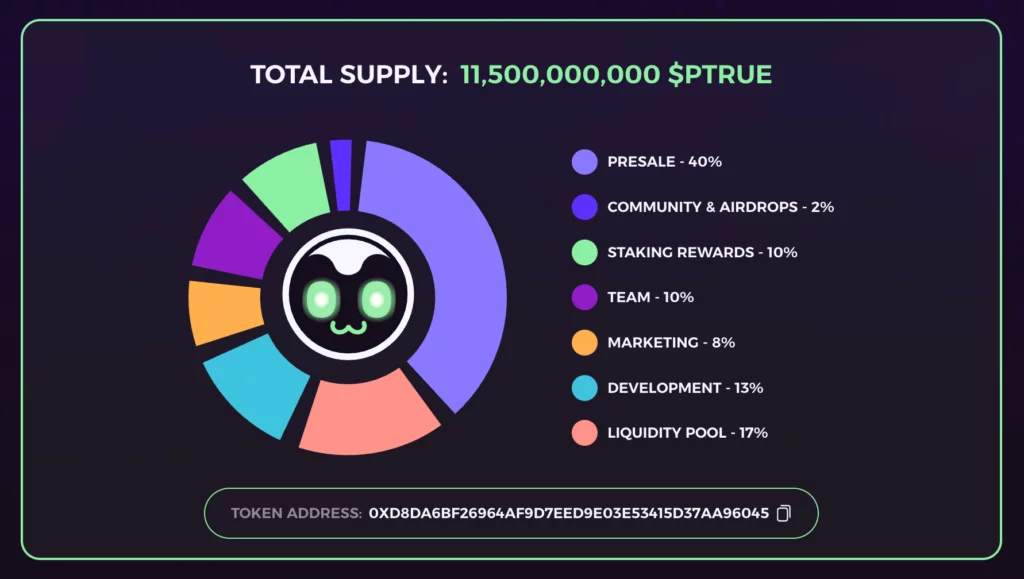
The project’s native token is PTRUE, deployed on Ethereum. The total supply is set at 11.5 billion tokens, with the current presale price listed at $0.001190.
Token distribution breaks down as follows:
| Allocation | Percentage |
| Presale | 40% |
| Liquidity | 17% |
| Development | 13% |
| Team | 10% |
| Staking | 10% |
| Marketing | 8% |
| Community/Airdrops | 2% |
The staking program advertises an APY of 4,452%, a figure that reflects early-stage incentive structures common in new token launches. As with any high-APY staking model, the actual yield depends heavily on the number of participants and total tokens staked over time. These rates typically compress as adoption grows.
PTRUE Token can be purchased during the presale using ETH, BNB, SOL, USDT, USDC, credit card, or SEPA bank transfer, a notably wide range of payment options for a project at this stage.
Who is Poly Truth built for?
The most natural use case is someone who actively participates in prediction markets and wants a more structured way to evaluate events before taking a position. Rather than relying on crowd sentiment or headline noise, users get a probability-weighted analysis drawn from aggregated data.
It also has potential utility for:
- Casual participants who engage with prediction markets around major sports events or elections but lack the time to research outcomes independently
- Analysts and researchers who want a secondary data point to cross-reference against their own models
- Crypto-native users interested in prediction market infrastructure as a growing sector within DeFi and decentralized governance
A few things worth watching
Poly Truth is still in presale, which means the core product is not yet publicly live in a tested, production form. The quality of the AI analysis, specifically how accurate the Starlet’s probability assessments are over time, will be the central test of whether the platform delivers on its premise.
Accuracy and transparency of methodology will matter more than anything else for a tool whose value proposition is built entirely on being analytically reliable. Users will reasonably want to know which data sources the Runners pull from, how the Starlet weights conflicting information, and how historical predictions have performed.
These are questions that typically get answered post-launch, through track record rather than documentation alone.
The bottom line on Poly Truth
Poly Truth occupies a specific and underserved niche: analytical infrastructure for prediction market participants. The concept is coherent, the three-part system is well-framed, and the target use case is genuine. Prediction markets are growing in visibility, particularly in crypto circles, and the demand for data-driven decision support in that space is real.
Whether the execution matches the concept is something that only a live, working product can demonstrate. For now, Poly Truth is worth tracking as an example of AI-assisted tooling moving into the prediction market vertical, a space that, until recently, has remained largely intuition-driven.
More details can be found on the official Poly Truth website.
Disclosure: This content is provided by a third party. Neither crypto.news nor the author of this article endorses any product mentioned on this page. Users should conduct their own research before taking any action related to the company.