


Chainlink now secures more than $110 billion in onchain value across cross chain tokens and DeFi markets, underlining how central the oracle network has become to the infrastructure of digital assets and tokenised finance.
- Chainlink reports $110 billion in Total Value Secured, with $60 billion in cross chain tokens over CCIP and $50 billion in DeFi data feeds
- The network has enabled $30.31 trillion in cumulative transaction value and published 19.39 billion verified messages onchain as of late May 2026
- Chainlink Reserve holds 3.78 million LINK worth about $37 million, funded by protocol revenue that links TVS growth to tokenomics
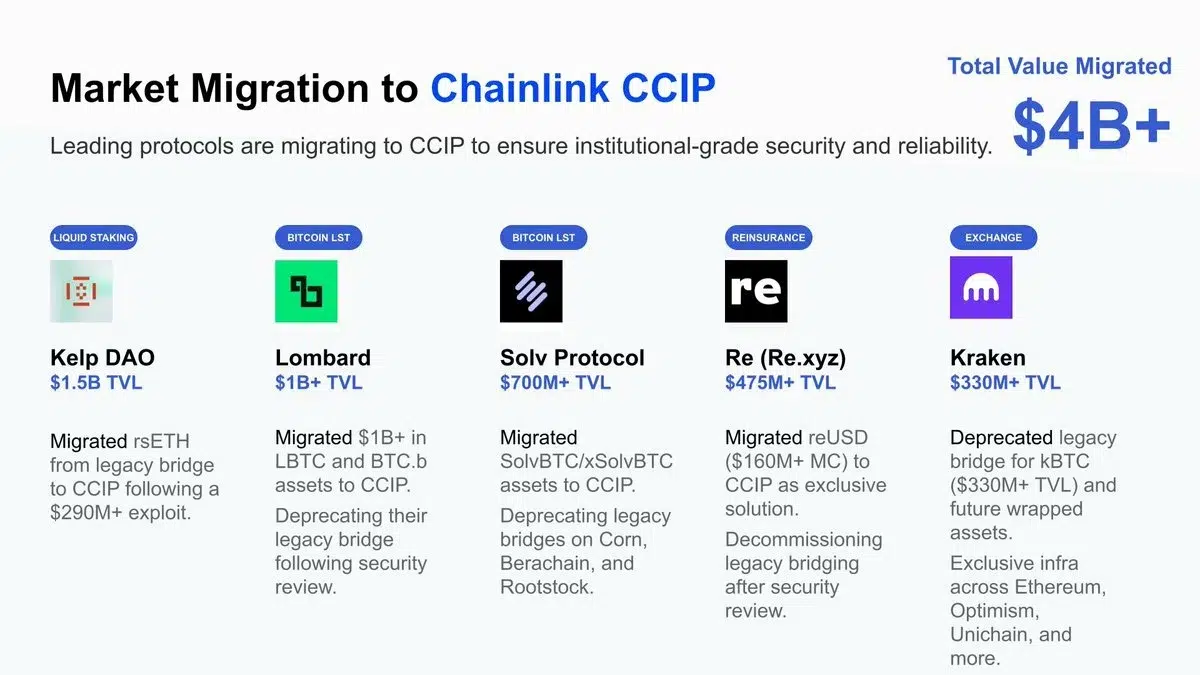
- Recent migrations from LayerZero to CCIP by Solv, Kraken and others have pushed more than $4 billion in assets onto Chainlink’s cross chain stack after a $292 million exploit
Chainlink (LINK) has pushed past $110 billion in Total Value Secured (TVS), marking a new record for the oracle network and underscoring how much of crypto’s plumbing now runs through its rails.
As of May 22, 2026, roughly $60 billion of that is tied to cross-chain tokens moving over Chainlink’s CCIP, while around $50 billion sits in DeFi data feeds that help price loans, derivatives, and stablecoins. In macro terms, that stack of value is now on par with the annual GDP of a mid-sized national economy.
Chainlink defines Total Value Secured as the dollar value of assets that rely on its services to function safely, rather than deposits locked inside its own contracts, which means TVS captures loans, derivatives, stablecoins and cross chain tokens that depend on its oracle and messaging infrastructure.
Chainlink’s own dashboard shows a narrower DeFi only view of $47.33 billion secured, which lines up with the second bucket in the headline number and underscores how much of the growth has come from cross chain flows.
Beyond the headline, Chainlink metrics show $30.31 trillion in cumulative transaction value enabled and 19.39 billion verified messages, a scale that covers everything from micro DeFi trades to institutional settlement and real world asset flows.
The public ecosystem directory lists 2,672 live integrations as of May 18 2026, ranging from consumer apps to capital markets infrastructure, with names like Swift, DTCC, Fidelity and UBS using Chainlink as a data and interoperability layer.
That footprint has kept Chainlink’s oracle market share in a band between 60 and 68 percent of category TVS over the past two years, according to several independent analyses.
How has Chainlink reached $110b in value secured
The financial side of the network shows the same expansion. The Chainlink Reserve, an onchain buffer funded by protocol revenue, holds 3.78 million LINK with a reported cost basis of $12.48 per token and an aggregate value near $37 million as of May 22 2026, after an inflow of more than 123,000 LINK on May 21 when the $110 billion milestone was confirmed.
Because the Reserve is topped up by fees from both onchain and offchain services, growth in value secured and growth in the Reserve tend to move together, linking adoption metrics to tokenomics for LINK holders.
For readers looking to track how this feeds into market structure across large cap assets, coverage of Bitcoin (BTC) pricing, Ethereum (ETH) staking and the broader perpetual futures complex is already available on crypto news, including explainers on how data feeds and cross margining shape risk in the sector.
The outstanding question for LINK investors is how much of the enterprise and cross chain activity converts into onchain fee accrual that can be captured through staking and token mechanics, versus revenue retained at the application or institutional layer, a debate that has now been running for at least two years in research from banks and specialist crypto desks.
As one research note from Galaxy framed it, Chainlink is “becoming the data and interoperability layer for onchain finance,” but valuation will ultimately depend on how aggressively that role is monetised at the token level.
Why is CCIP driving the latest surge and how does risk migrate
The fastest moving component of the $110 billion total is CCIP, which has accelerated sharply after bridge security failures pushed protocols to reconsider their cross chain stack.
A $292 million exploit at Kelp DAO’s LayerZero powered bridge in April triggered a visible migration, with projects controlling more than $3 billion in DeFi value shifting infrastructure toward Chainlink’s CCIP in the weeks that followed.
Solv Protocol moved around $700 million in tokenised Bitcoin on May 7, while Kraken announced that it would fully deprecate LayerZero and adopt CCIP as the exclusive cross chain layer for Kraken Wrapped Bitcoin and all future Kraken Wrapped Assets, a change that ultimately covers more than $4 billion in value.
CCIP already supports transfers across dozens of networks, with Coinbase using it for wrapped assets and Lido deploying it for wstETH routing, while cross chain tokens under the CCT standard now move across more than 60 chains.
That breadth matters for tokenised real world assets. BlackRock, JPMorgan and Fidelity have framed their onchain treasury, money market and commodity products as a step toward a more programmable capital market, but those instruments only function at scale if they have reliable price data and a way to move between chains without custom bridges for every deployment, a combination that makes Chainlink’s dual role as oracle and messaging layer strategically important.